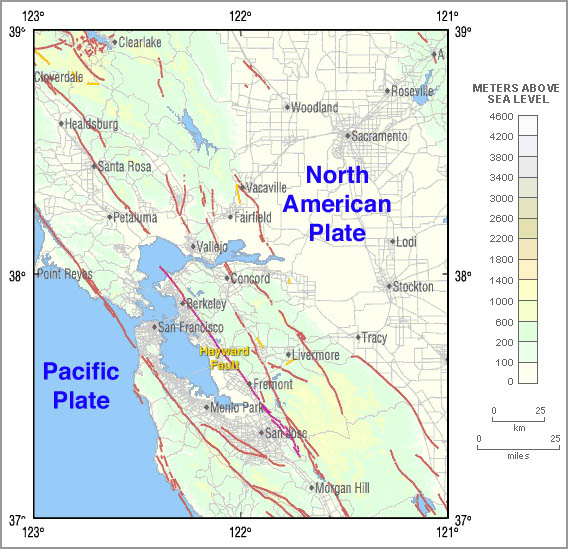
By now we’ve all seen via the news- the destruction left behind by the 7.0 Haiti earthquake on January 12th, 2010. We’ve seen and heard of structures from palatial buildings to shantytown shacks being reduced to rubble trapping untold victims beneath. We’ve seen the images of folks walking dazed in the street in shock over dead or missing loved ones. We’ve seen the images of folks calling out for help. The calls asking for water, food, help shoring up a building or help searching and rescuing a trapped person. These images are all disheartening and should serve as a MAJOR wake up call for those of us in the Bay Area. There are at least four major faults that run through the fifth largest metropolitan center in the nation. The San Andreas runs through the South Bay from Southern California up through Peninsula and put to the Pacific Ocean from western Marin County. We’ve experienced major quakes on this fault line- most notably the 1906 quake and the most recent- Loma Prieta Quake of 1989 centered in the Santa Cruz Mountains some 70 miles away from San Francisco.
The Loma Prieta quake killed 63 people and damaged infrastructure from Santa Cruz to San Francisco and Oakland. Unlike the Haiti quake, we were spared somewhat due to tougher building codes, the fortunate timing of the quake and the fact that it was centered in a relatively remote coastal mountain range away from the major population centers.
We now face a much larger threat from the Hayward Fault. The Hayward Fault runs from about Fremont through the large population centers of Hayward, Oakland, Berkeley , Richmond, and out to San Pablo Bay from Pinole (where it is thought to meet up with the Rogers Creek Fault). There are over a million people who live within 5 miles of either side of the Hayward Fault Zone. I myself live well within the fault zone in the San Pablo Hills and a mere football field away from of the fault trace (the geographical marker of the fault.). The Hayward Fault last experienced a major quake in 1868. Geologist have determined that this fault experiences a major quake like clockwork on average, every 140 years. We are now well within the statistical margin for experiencing a big one on the Hayward. A quake anywhere along this fault is dangerous- a quake on the northern part of the fault (from San Leandro to Pinole) would be extremely devastating. Major East Bay infrastructure would be disrupted as many hospitals, colleges, watersheds, and freeways would be disrupted.
Like we’ve recently witnessed with the people of Haiti and New Orleans, we will be “on our own” for a long period of time. The rule of thumb is that emergency crews will be tied up for 72 hours and that we should be prepared to “tough it out” for that period of time with limited or no infrastructure including rescue, power, water, communications, highways, and supply distribution. We’ve been fortunate enough to “Monday Morning QB” these previous disasters and we ‘ve all lamented that in reality, infrastructure takes a lot longer than 72 hours and it may be weeks before things get back to normal.
Yesterday is the time to prepare for the inevitable disaster that will undoubtedly change our lives. It is however not too late. Below is a how you can prepare to keep your family going while chaos is reigning after our own disaster.
Develop emergency kits.
You should have emergency kits for your work, car and home. These should consist of items that can fit into a good size backpack and be portable. These should NOT be your main disaster kit but one that will allow to get home or evacuate your home and keep you and your family good until things normalize. These kits need not be expensive. My kits consists of canvas military backpacks from Berkeley Surplus and items from this store and local $.99 / dollar stores. These need not cost more that $25-$30 in total each. You can also purchase premade ones from places like REI, the Red Cross, The Earthquake Supply Center, eBay, and many other places. You should also have a larger kit at home. This can be kept in a trunks, a 55 gallon drums or any large centralized container.
This link includes what you should have in your kits and how to develop a disaster plan.
Also take advantage of free classes offered by most communities on disaster preparedness. I recently completed a CERT (Community Emergency Response Team) training offered by the City of San Pablo. There is a class starting up for all West Contra Costa residents in March (you can also take classes with EL Cerrito, Pinole, or San Pablo) Classes are also offered in:
Tips for emergency preparedness can be emailed to you weekly to keep you on your toes from CARD- an Oakland based disaster preparedness non-profit.
Develop a plan with your community outlets- like your church, worksite, homeowners association, neighborhood watch, school, etc., so that you and your immediate friends and family are on the same page.
If we take the relatively little time and effort to prepare, we will that much better when our disaster hits us. I encourage you to offer your own suggestions in the comments, share these thoughts with those around you and most importantly, develop your disaster plan and kits without hesitation. You need not break the bank, every thing you need can be secured from dollar stores and Big Lots. It will be well worth it.



No comments:
Post a Comment